Thursday, May 17, 2012

THE GRACEFUL PEONY


When I first came to live in Palo Alto I noticed a white Peony tree in a tiny neglected garden across from Jordan Middle School, where North California street meets Middlefield Road. It was spring and the small tree was covered with enormous white flowers.

It suddenly occurred to me that I, too, can grow Peonies in my garden. 


We just moved in. We designed our garden by ourselves and every weekend we created our garden. We made two small triangular beds on both sides of the short trail to our home. One bed lay at the beginning of the trail, on its left side, when you face the house, and the other at the end of the trail on the right side. We surrounded the beds with English boxwood under the impression of Kew gardens in England. In the front bed we planted three Peony bushes, in the bed close to the house we planted Peony tree. 


Few years passed. The bushes disappeared during the summer. The tree was covered with healthy green leaves. We waited for the flowers.

Then one spring we opened the door and the two beds turned into a huge crown of huge, pink flowers, filling the air around with light, pleasant fragrance. 


But the weather…

The sky turned grey, the wind blew.

Pouring rain hit the silk petals,

Destroying the magnificent view

The weather gave us only one day to enjoy the bouquet.

Twenty years passed since I planted the Peonies.

Every year, a wet or dry year, when the Peonies open

I know “Rain is in the horizon.”

Peonies are subject of many books, websites and art.

I will not reiterate what was already said in books and websites, but since I love legends and I love art I will repeat few famous legends and I will make a minimal Peony art exhibition. Maybe in the future I will add more legends.

One day when I retire I will devote more time to grow more Peonies and to understand their history and secrets.

A CHINES LEGEND
The legend is about a young scholar and his flowers' garden.
One day a young maiden visited the garden and  admired it. The young scholar hired her as a servant, but soon she became his companion and they fell in love with one another. 
One day they expected a visit by a moralist. The girl disappeared.  The young scholar searched and searched for her and finally he found her in a gallery in his home. She appeared to him as a shadow fading into the wall.
"I was the soul of a peony" she told him "I had been warmed into human by your friendship and love. The moralist will not approve our love. I must return to the world of the flowers."
Then she disappeared.
The scholar went into deep mourning, continue to tend to his garden and search for her return.
He never saw her again.
(The legend appears in "The contemplation Upon Flowers by Bobby J. Ward)
 
 
PLUTO, PAEON, and AESCUAPIUS
The watchdog of Hades wounded Pluto, the ruler of the underworld. Pluto called Paeon, the young physicians under Aesculapius, the most famous god who had the power of healing. Paeon consulted Apolo’s mother and with her help he cured Pluto quickly with a special herb.
Aesculapius was jealous.
The fire of his jealousy flared up and he brought death upon Paeon.
Pluto was furious. He could not bring Paeon back to life, but he turned him into a magic plant, the peony. 

(The legend is one of many versions that appear in the Greek Mythology)
The myth surrounding the tale says: 
“Peony is the first herb ever in Medicine. 
It can force out a devil from the innocent.
It can eliminate a powerful enchantment.
It can drive away a witch and 
It can scurry a ghost to its grave.”


Mischievous nymphs were said to hide in the petals of the Peony thus causing this magnificent flower to be given the meaning of Shame or Bashfulness in the Language of Flowers. Once planted the Peony likes to be left alone and punishes those who try to move it by not flowering again for several years. Once established, however, it produces splendid blooms each year for decades (Taken from The Language of Flowers, edited by Sheila Pickles, 1990).


Diana Wells in her book “100 Flowers” tells us that Peonies can live for hundred years or more if undisturbed.”


Peony is known as "flower of riches and honor" and is used symbolically in Chinese art.

Peony is the state flower of Indiana since 1957.

Peony flower is the traditional floral symbol of China and Mongolia.
Peonies, the most beautiful flowers on earth, their color, delicate petals and light scent graced many paintings:

 Pierre-August Renoir, 1880, - Peonies

 Vincent Van Gogh – Vase with 
Poppies, Daisies, 
Cornflower and Peonies.

 Henri Fantin-Latour – 
Vase of Peonies,  
 White Peonies and Roses Narcissu


 William Merrit Chase, 1903 – Peonies


 Edouard Manet, 1882 – Bouquet of Peonies


 Yan Shouping – 1633 – 1690 
major artist of the early Chinese Qing dynasty

 Peonies in Chinese Stamps

(All the painting are from wikipedia.org)


Our Peonies

Thursday, July 1, 2010

Trail of Flowers in Henry Coe State Park


Sigal was the guide on wild flower hike in Henry Coe State Park. It turned out to be a family hike, grandparents, parents and grandchildren. We ventured down the narrow trail slowly searching for new flowers. We found a lot of flowers, many of them were new for us.
Here are some of the beautiful flowers we saw on the trail. Amos captured most of the flowers with his camera. Sometime I also could not resist and took turns with him.


The woody shrub, Blue Witch , is also known as Blue Nightshade I found some information about the flower in the following site:
http://www.almaden.ibm.com/almaden/environs/wildflowers/index.html
The Blue Witch blooms all spring and summer. It has grayish-green leaves and makes green berries about the size of a hazelnut. The berries develop in May and June. Yes, this shrub is related to Deadly Nightshade. All parts of the plant contain the deadly alkaloid Solanine. Surprisingly, it is also a close relative of the tomato and potato. The cultivated "potato bush" looks a lot like it, but the petals of the potato bush are darker and don't have the little yellow or white spots on each petal. The wild tomatillo is also in the Nightshade family. Apparently, it took two hundred years for Europeans to get up the courage to eat tomatoes. Can you blame them when a few berries of the Deadly Nightshade can kill?" -

The Gilia a delicate flower- bears for a long time a succession of blossoms either blue, white, lavender, or rose-colored. In the Henry Coe Park, we saw the Blue Gilia, later when we hiked in Point Lobos we saw the rose Gilia.


California Sun Flower – The beautiful book “The Secrets of Wild Flowers” by Jack Sanders devote a chapter for the Sunflowers. The subtitle summarizes the flower’s properties and qualities: “Sunflowers feed and entertain humans and birds and inspire artists.” Everyone who loves flower will enjoy the words about the beauty and the treasures of the Sunflowers family.
Vincent Van Gogh painted series of "the Sunflower". Some experts say that the sun flowers painting are his most beloved.Wikipedia has a dedicated page for the "Sunflowers" http://en.wikipedia.org/wiki/Sunflowers_(series_of_paintings)


The Chinese houses flower gets its name from layers of flowers which resemble a small collection of towers of decreasing diameter that looks like a pagoda. The scientific name is Collinsia bartsiifolia ssp. davidsonii -
Davidson's Blue Eyed Mary. The shining white and light purple colors of the flower and its shape is very special and has some calmness about it.


The Dense Flowered Lupine – Lupine is a wild flower. In the photo, one sees a branch with flowers and a branch with the pods. The Lupine is part of the Pea family. There are many species of Lupine; many of them can be viewed in the site:
http://www.calflora.org/
The source of “lupine” word is the Latin word “Lupinus” meaning “wolf”. In the ancient, world, people believed that the Lupine flower was like a wolf, robbing the soil of its nutrient material and destroy it. Today we know that the Pea family plants add nitrogen to the soil.
Old Greek tale, tells a story about Zeno of Citium of Crete (262 B.C), the famous founder of the Stoic School: Zeno, after drinking enough wine, compared himself to Lupine – Lupine loses its bitterness taste when soaked in water.
Another Greek story tells us that visitors to the Oracle of the dead, on the back of the river Acheron, Epiros, were fed with Lupine peas, which prepared them to communicate with the dead.
There are hundreds of species of Lupine. The Lupine produces flat seed-filled pods. Many species of Lupine are poisonous to livestock. If the pods are eaten in large quantities, they can cause poisoning.
A reference to these two stories I found in the book “Florida Ethnobotany” by Daniel F. Austin. If you have reference to the source of the stories, let me know.
A very interesting and fascinating article about the lupine appears in the following page: http://www.oldandsold.com/articles19/flowers-16.shtml
One paragraph is about the advantage gained in the pea-shaped blossom and anther paragraph is about sleeping habits of the lupine.
A Scientific article In the American Journal of Botany 64(8); 1032-1041. 1977, is about “Sun tracking and Related Leaf Movements in a Desert Lupine (Lupine Arizonicus)
http://www.jstor.org/pss/2442259
Lupine became popular in the garden when George Russell hybridized them. He lived in Yorkshire England, as a railroad guard. You can read about his passion for Lupines and see some photos of his sensational flowers in the following site:
http://www.godsowncounty.co.uk/03/yorkshire-folk/the-lupin-man-of-york-george-russell/
It is said, “Everybody loves Lupine”. In the coming year I will devote few square yards for Russell Lupine. I will try to start them from seeds.


Derived Microseris Flower – Microseris Douglasii – The flower is an annual herb native to California.


Douglas Violet - Commandant Violet Blanche Douglas-Pennant (31 January 1869 – 12 October 1945) was a British philanthropist and supporter of local government who served as the first commandant of the Women's Royal Air Force (WRAF) until her dismissal in August 1918.
These lines are part of an entry about Douglas Violet in Wikipedia:
http://en.wikipedia.org/wiki/Violet_Douglas-Pennant


Monday, May 31, 2010

May 29, 2010 Garden Day

My muscles were tired. My legs hardly carried myself from one side of the garden to the garbage pans. Piles of leaves were scattered on the trail. Slowly I carried them to the pan. In my mind I debated with myself: “shall I plant now the last tray of flowers or shall I postpone it?”

In my thoughts, I went over my imaginary to do list:

Mop the trail between the beds where I have just weeded, cleaned and planted purple and pink impatiens.

Water the new plants.

Water the Weigela bush I had planted few days ago.

Spread some pellets to stop slugs eating the purple violets.

Water the sweet peas and cucumbers.

Water and prune the small English dogwood which slowly takes a shape of a dinosaur.

And water the herbs’ pot.

“No” I told myself “I will plant the second tray of flowers tomorrow.”

I completed my assignments, enjoyed again and again the view of the bed with the new and the old flowers.

The sun was advancing towards the Pacific, but it was still high in the sky. The sky was deep blue, the light colored the garden with special fresh shades and I could not resist taking some photos.


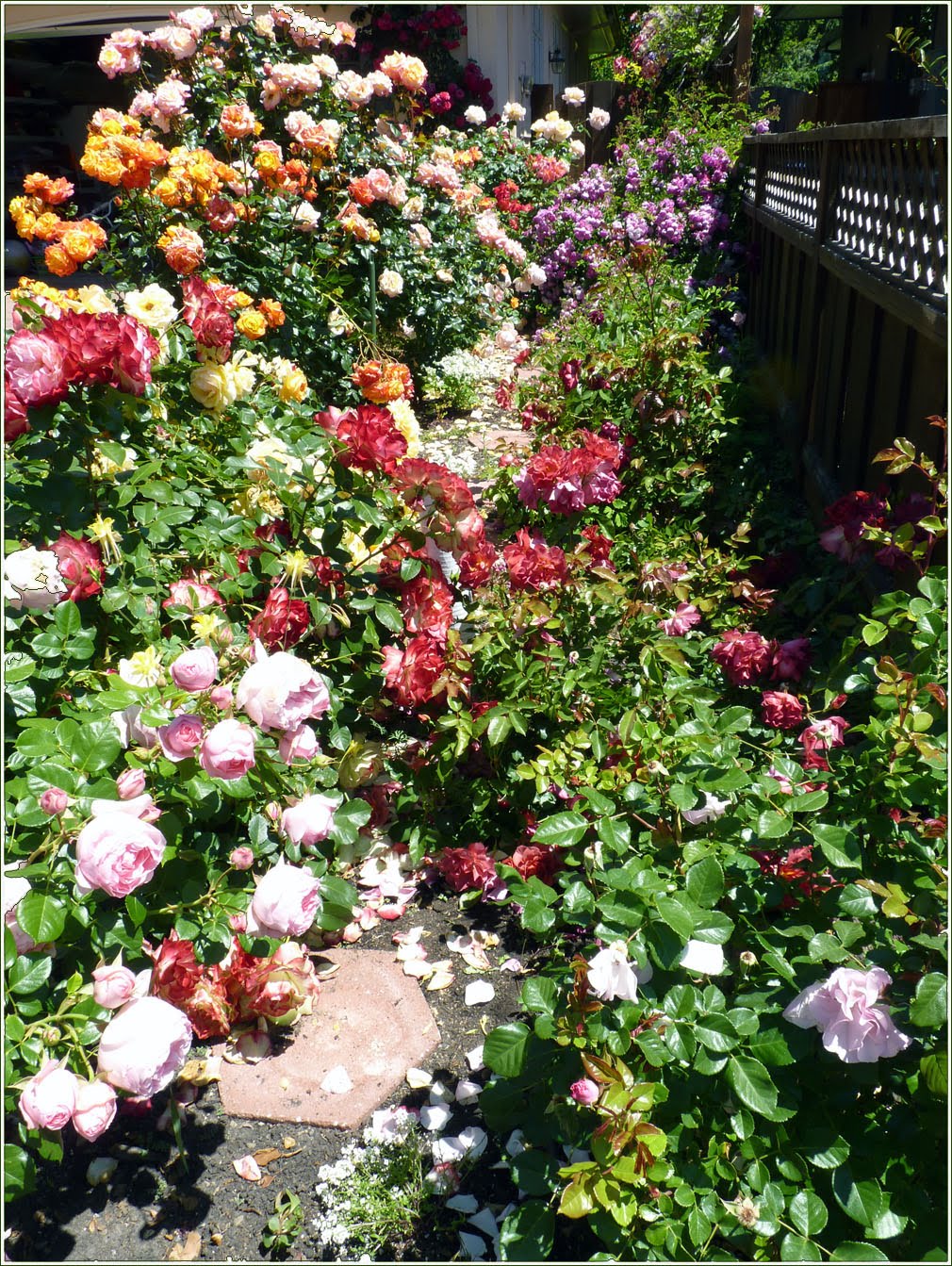
The roses,in front of the house,still have a grandiose show.


The new rose, with purple petals and strokes of white, blooms like a shy girl.


In the backyard, under the kitchen window, the roses, the Irises, the Columbine and the Foxgloves are woven together wildly. I love the jungle of flowers in this corner.


The Lilies are starting to bloom in many corners.


The king of the flowers, the Amaryllis, rises from the bulbs. A special chapter will be later devoted to the elegant Amaryllis flower.


On the fence between us and our neighbors several different Clematis vines are climbing. Looking at them closely I discovered that most of the flowers have four petals, some have six petals and some have five petals. I take a close up photo and the texture and the design of the petal comes out clearly.


Last,I look at the Chamomile flowers. I have not yet tried making tea from the flowers.


While writing the blog I found out that slug pellets might kill birds. The article has some suggestions how to create an anti-slug garden. Apparently there are some slug resistant plants. Now I have to study the list of plants and bring some of them to the garden. I would like to attract birds to the garden,not to kill them. The best suggestion, in the article, is to attract slug predators. The paragraph ends with the exciting words: “Hedgehogs, foxes and badgers all eat slugs.”
I ended the day with a thought: “My grandchildren would love to have a hedgehog strolling slowly in the garden. I remember one morning in my childhood. I was three or four years old, my father waked me up and lead me out to the yard. A wooden box was standing up side down on the balcony. Slowly my father lifted the box. Underneath a hedgehog was curling.”
When Amos and I lived in Shlomzion Hamlka Street, Haifa,hedgehogs were living in the fields around the house. More than once, Amos succeeded to capture one under a box, but in the morning, when he and the girls lifted the box with excitement, the Hedgehog was gone.

Wednesday, May 19, 2010

Rose - - The Queen for All the World Flowers

For me Rose is the queen of all flowers. Slowly I plant more Roses in my garden even though I am unable to thin thread among the plants that are already spreading widely in every corner of the garden. I am already aware of the sad status quo between me and the space: “No More.” To calm myself I secretly plan to set up a Rose garden on the soil of my neighbor. I am sorry to say that this plan will be accomplished only at the beginning of 2011. At this time I will, also, add one more climbing Rose to my garden. In my imagination it is already climbing on the top of the arbor above the gate on the right side of the house. I have enough time, about six month, to ask Amos to build the arbor for me and at the same time to make him believe that it is his idea in the first place.


The Roses in my garden enjoyed the 2010 rainy winter. The first flowers bloomed on April 17.


Now a month later they are ablaze even though I already have to trim the old flowers. I walk with the pruning shears and clean the fading flowers. I collect the tiny branches in a pail. I look at the pail down and the pile grows high. I look up at the Rose bushes and there is no sign for vanishing flowers, more and more buds open and fill the crown of the queen of flower.


The bed floors are covered with fresh petals. Walking through the short trail to our home is like walking in a delicate unseen cloud of the sweetest perfume on earth.


Our first experience with planting roses here in Palo Alto was twenty years ago. Today our yard is divided to the old yard and the new yard. In our old yard, the previous tenants, the Millers, left a bed with four beautiful fragrant Roses in the backyard. We planted different red roses in the front yard bed and Rose bushes in the backyard. All of the plants are now full with flowers and fragrance. I never cut the flowers, but Amos brought me two flowers and I enjoy their sweet perfume around the kitchen table. The southern fence of our old yard is covered poorly with light pink climbing roses. Too much pruning probably was bad for them. I do not know the name tags of the roses in the old yard.
The most exciting rose show is in our new yard. When I started planting the roses unfortunately I did not kept record of their names. Hopefully I will slowly search and find their names.
Some of the ancestors of the roses in my garden are mini roses sold at piazza food market for decorating the table at home. Once the flowers faded I planted the mini rose in the garden. Few grew up and forgot they were once mini roses. Here is one that turned into a climbing rose.

Our Gargage door is decorated with two climbing red roses. The climb slowly above a beautiful arbor made by Amos when we just moved into the house. I got the two climbing roses from my friend Mindle who shares my love for Roses.

The most beautiful climbing rose in the garden is trying with great success to welcome who ever go through the southern gate to our garden.


You can read in many web sites and in many books about the Rose. The Wikipedia has beautiful pages:
http://en.wikipedia.org/wiki/Rose
Lately I bought most of my roses, bare roots, from Jackson and Perkins
http://www.jacksonandperkins.com/gardening/GP/homepage/GardenRoses
Some time when I am not lazy I drive across the Dumbarton Bridge to Regan Nursery in Fremont.
http://www.regannursery.com/
I love paging through the Jackson and Perkins catalogue. When I go to the Regan Nursery I take the catalogue with me. I slowly stroll among the hundreds of Roses, read their names, search for their character in the catalogue, and debate with myself and with Amos which one to buy. Our last visit to Regan was about a month ago. The new Rose we purchased was Salsa.


Many yards in Palo Alto now in May 2010 are exploding with blooms of Roses.

Writing the blog stirred me up to look for legends, stories and poems about the flowers in my garden. Roses are subject of an infinite number of books, essays, poems and legends.
Last night while writing the blog I enjoyed reading Oskar Wilde's story "The Nightingale and the Rose"
http://www.literaturecollection.com/a/wilde/330/

Wednesday, May 5, 2010

Russian Ridge Hike April 17, 2010


On Saturday afternoon, after a debate on the subject "To work in the garden or to hike nature garden," we drove up Pagemill Rd. to Skyline Blvd. We hiked among the green hills of the Russian Ridge Open Space and took photos of the wild flowers. In spring as we hike and the hills are green we always say:
"Soon the hills will be dry."
I always add:
"They are green only for a couple of months."
I like the openspace with the fields of flowers and I like the Ancient Oak Trail.


The fields were dotted with small flowers:

California Poppy


Buttercup


Johnny-jump-ups (Viola pedunculata)


Tidytips (Layia Platyglossa)


The Midpeninsula Regional Open Space District website has information about the Russian Ridge.
http://www.openspace.org/preserves/pr_russian_ridge.asp